


The transition to lung breathing takes time.
Your baby needs a continuous supply of blood when it has to switch to breathing through its lung. When the umbilical cord stops pulsating after birth, it becomes clear that the baby actively switchet to its own blood circulation system. This allows the transition to take place without fear or hesitation. There is a risk to the baby if the cord is cut too early.
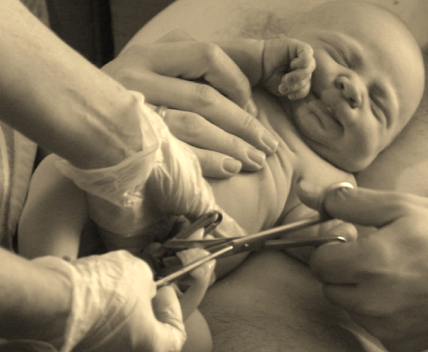 We are all familiar with the feeling of diving in a swimming pool and running out of air before we resurface. To collect umbilical cord blood for other purposes, the umbilical cord must be clamped and cut within 30 seconds of birth. This has been shown to cause the baby to lose at least a third of its total blood volume. Your child may also experience a brief lack of oxygen, accompanied by a fear of suffocation. This is not trivial but can have a conditioning effect on the baby’s memory: fear = not getting enough air. As early as 1924, a link was established between premature cord clamping (separation from the mother) and the development of asthma later in life. Otto Rank: “The direct physical manifestations of the birth trauma also include all neurotic breathing difficulties (asthma), which re-enact the experience of suffocation…” (Rank, new edition, Fischer Verlag, Frankfurt, 1988, p. 67). A Danish study on respiratory conditions following caesarean section has found that babies born by caesarean section are four times more likely to develop respiratory conditions in their first year of life. Dänische Studie: Lungenprobleme nach Kaiserschnitt (englisch) Link wird übernommen.
Summary: A Danish study of 35 000 newborns examining the link between caesarean section and respiratory dysfunction.
Prof. Dieter Köhler, a member of the Scientific Advisory Board of the German Society for Pneumology and Respiratory Medicine (DGP), discusses a Danish study on newborns. (Of these 35 000 children born between the 37th and 41st weeks of pregnancy, 2 687 were delivered by caesarean section without medical indication, 788 of whom were elective caesarean sections. Prof. Dieter Köhler: “The risk of respiratory disorders remains significantly increased even when the caesarean section is performed close to the calculated due date of birth … This is probably due to the absence of the catecholamine surge that occurs during a caesarean section.”
These stress hormones are released by the mother during a normal vaginal birth as a result of the contractions and pain experienced as the baby passes through the narrow birth canal (or, as well, once labour has started, during an emergency caesarean section); they are therefore a natural part of the process, but are apparently also beneficial and necessary for the development of the newborn’s lungs.
Thus, during a vaginal birth, the catecholamines ensure that less fluid is secreted into the baby’s lungs whilst simultaneously stimulating the production of an important substance – known as surfactant – which expands the alveoli and makes the baby’s first deep breathing easier… . Caesarean sections of this kind have become significantly more common in recent years…
Many pregnant women apparently shy away from the pain and exertion of a vaginal birth; some even believe that a caesarean section is less stressful for the baby, too…
However, this is not the case – on the contrary, as the Danish study has shown, babies born by elective caesarean section struggle much more to breathe than those born vaginally. Serious complications requiring reanimation occurred around five times more frequently following a caesarean section. One in ten babies delivered by caesarean section in the 37th week of pregnancy experienced respiratory problems – such as a temporarily increased respiratory rate or persistent pulmonary hypertension. In children born at the same gestational age but delivered vaginally, however, such complications are observed about four times less frequently. In view of these figures, a caesarean section performed at the mother’s request or the insistence/recommendation of the doctors cannot really be regarded as the method with fewer complications or the gentler option – let alone recommended – as long as there is no medical necessity for it.
Source: Press release from the German Society of Pneumology and Respiratory Medicine (DGP) dated 23 January 2008.